



In Europe, perhaps more so than in the United States, companies who advertise on television have developed extremely clever and memorable advertising. Like many multi-national automobile companies, Honda is known for coming up with highly entertaining ads. From using their individual car parts to create a domino effect, or by using a human choir to recreate the noises of their vehicles (you can find these, and others, on websites like Youtube), this car maker has created ads that get people talking. Their latest idea was no different. The team from Torrance, California-based American Honda wanted to create a musical highway using rumble strips and they wanted their Honda Civic to play a musical score as it traveled over the strips. Rumble strips are the rough patches of road that make a loud noise to wake motorists up if they veer outside a lane. The concept had already been successfully realized in countries like South Korea and Japan; however this would be the first musical highway of its kind in the U.S.
Did you know?
Roadway departments all over the world have spent years experimenting with various devices and measures to guard against accidents while maintaining driver safety. Some are designed to
reduce traffic speeds or ease congestion while others are installed with the intention of keeping correct road position or providing hazard warning notifications.
Audio tactile profiled markings, or rumble strips, are a safety feature that warn drivers of potential dangers or deviations on roadways. They do this by causing vibration and audible rumbling when a car travels over them. These vibrations are transmitted through the wheels into the main chassis of the vehicle, and together with the noise produced, alert off the roadway.
Rumble strips were first implemented on the Garden State Parkway in New Jersey in 1952. Also known as singing shoulders, they provided an alert system to prevent the ever-increasing problem of drivers straying from the roadway. Since this time, research has shown that rumble strips are a highly effective way of reducing many types of accidents and they are cost effective as well. The effectiveness of rumble strips has remained consistent over time, while other road safety measures studied at specific installations have often shown a decline in their effectiveness as drivers become accustomed to them. Cost-benefit analysis have shown that even on relatively low-volume roads, the costs associated with creating rumble strips are quickly exceeded by the economic benefits of improved road safety.
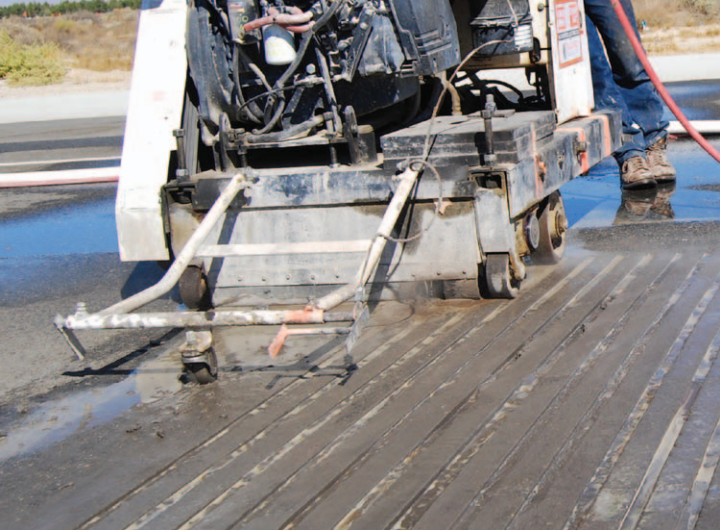
Rumble strips are usually applied in the direction of travel, along an edge or centerline, to alert drivers when they are drifting from their lane, or across the direction of travel to warn drivers of a nearby danger-spot. These strips are created by scalloping or grooving a section from the concrete or asphalt roadway using diamond cutting equipment in a regular pattern. Alternative types of strips can be created by forming raised sections or by adding thermoplastics or cold-applied plastic round or rectangular bumps. Certain types of raised rumble strips also have reflectors built into the edge to increase driver visibility. Round raised rumble devices are sometimes referred to as Bott’s dots. Whether alerting drivers or creating music, rumble strips get the job done.

Building the Musical Highway
RPA of Santa Monica, California, was hired by Honda to create a television commercial featuring the musical highway and the location, a quarter-mile stretch of road in Lancaster, California, was chosen. Pauline East, the Antelope Valley Film Office’s liaison said that the location was picked after Honda said it wanted a sense of community and city lights from one angle and a feeling of openness from the other. RPA heard about CSDA member Austin Enterprise through other road contractors and from employees at the California Department of Transportation (Caltrans). The contractor performs a lot of work for Caltrans on highways and on airport runways creating rumble strips. Many employees of Caltrans knew Ty Conner of Austin Enterprise because of Austin’s largediameter saw blades and grinding heads, and Austin Enterprise was approached to cut the grooves.
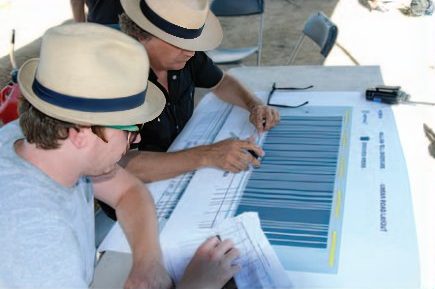
A musical score was translated into a series of strips and the Honda Civic, traveling at a speed of 55 miles per hour, would produce the series of vibrations and “hum” the score. The concept was similar to a record player needle gliding across a vinyl LP. Seven notes were required to create the music for the song that had been selected. Although the notes were repetitious, they were different in that they had varying durations of the note. Varying lengths of blank spaces were also inserted to create the rest of the music. Small blank spaces were used to give definition to each note. Larger spaces were inserted to maintain the beat of the song. Mathematical musicians made the calculations for the notes after three days of test cutting.
It was determined that three factors affected the making of the note: depth of groove, width of groove and spacing between grooves. Just one incorrect calculation and groove would make a big difference in the music that the production company was hoping to create. According to Conner, “Sometimes rumble strips produce too much vibration and noise and I’m called to try and reduce the noise.” He added, “This was one job that was actually fun in that I was called to create noise. Watching Park Pictures produce the commercial was a trip as well.”
This job had some interesting challenges. The 0.5-inch-deep grooves made transverse to traffic across the 12-foot-wide lane varied from 0.5 to 1 inch in width, with a tight tolerance of 0.05 inches. Great care was also taken to make sure the sections of road in between the cuts were the correct width. “The spacing in between the notes was really important,” said Conner. “The spacing of the strips had to be specific to get the right length of note as well as the right tempo,” added Conner. In addition, the cutters and the production team had to deal with the heat of the California sun which caused the surface of the asphalt pavement to soften. This, in turn, caused some distorting of the grooves so the operators completed a portion of the work at the night.
Austin Enterprise used a Meco 72-horsepower diesel groover with a 24-inch head, together with a 35-horsepower gas groover with a 16-inch head to make the grooves. A full day was taken to configure the grooving heads prior to commencement and 12-inch Diamond Products blades were used with various width spacers. Five operators completed the cuts over three days and eight-hour shifts.
There was a brief moment of panic for Conner and his operators, as they wanted to be the first to try out the musical highway. They proceeded to travel over the series of rumble strips in a 20-foot truck. The size and weight of the truck traveling over the grooves did not exactly produce sweet music, and the cutting team was worried that the project would not be a success. However, once the production crew from Park Pictures traveled over the strips in the test car, the team’s fears were allayed as they heard the excited shouts and screams of the crew, as it was clear that the cuts were correct. The project had been a success.
The stretch of highway in Lancaster soon became an extremely popular section of road, but not for some local residents. Residents complained about the weird noise coming from the road as well as the increased volume of traffic in the area. In addition, some motorists were making illegal U-turns or traveling over the strips in reverse, causing safety concerns. Mark Bozigian, City Manager for Lancaster, made the decision to repave the road to avoid any accidents.
This, too, proved to be an unpopular choice. “I was not a well-liked man,” said Bozigian, who had to deal with approximately 500 complaints about the removal of the strips. He then made the decision to reproduce the strips in a less populated area that would not cause as much disruption. Despite this setback, the city of Lancaster was pleased with the exposure provided by having it’s name and logo included in the commercial, “You can buy that kind of advertising, but not on our budget,” added Bozigian.
Patti Austin of Austin Enterprise, was also pleased to have been involved in such a unique job, “Our operators were overjoyed to hear that it was a success, and we are proud to have been a part of it.”
Watch for the ad that begins with the cutting work taking place, followed by two fellows getting into the car. From there, the ad is shot from the inside the car by a camera mounted in the middle of the back seat, with a microphone that was placed in the trunk that records the sound produced by the tires. The viewer takes the journey from a passenger’s perspective, hearing the tune play out as the car travels along the stretch of road. There are three different versions of the ad with varying lengths, so it will take a sharp eye to spot the shorter versions.
A visit to the westbound stretch of Avenue G between 30th and 40th Streets West in Lancaster, California, might just be worth it for a ride along the Honda Civic musical highway.
Article reprinted from Concrete Openings | June 2009