by austinenterprises | Mar 1, 2022 | Projects
Since OSHA implemented the “Respirable Crystalline Silica Standard for Construction” in 2017, wet polishing for concrete surface prep has dramatically increased. Wet polishing minimizes respirable silica dust in the air as it is trapped by the water, and for the most part reduces the breathing hazard to workers. However, mixing the concrete and chemicals with the water creates slurry, which introduces a new hazard and additional step for concrete renovation workers.

Slurry management and disposal is a crucial element of virtually any jobsite with major penalties for improper handling. Whether it be the detrimental environmental risks or the potential U.S. Environmental Protection Agency (EPA) fines, which start at $10,000 for violating only one of their laws, slurry simply must be handled properly. You cannot discard slurry into a dumpster or sewer, making it especially challenging to deal with substantial amounts of slurry that result from large jobs. To legally dispose of the slurry, you must first separate it back into its two primary components: concrete and water.
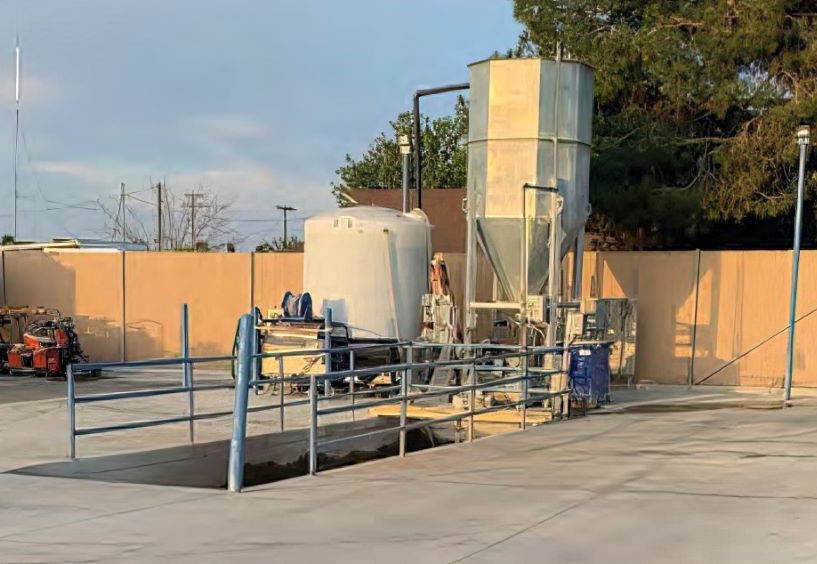
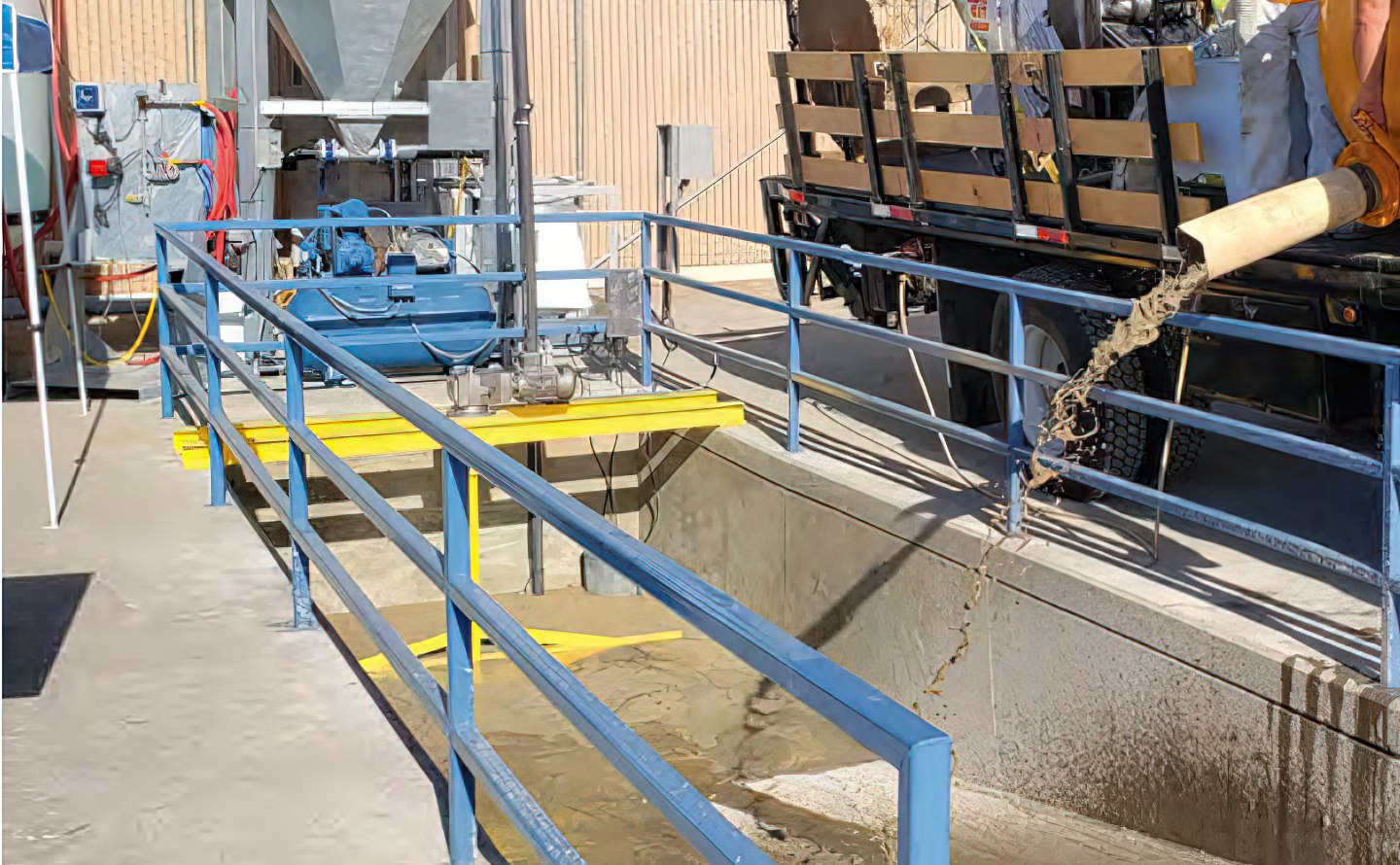
Slurry silos, though relatively new, are being used widely in the concrete and stone industries. One example is the Decanting Silo by Full Circle Water, which uses gravity to separate the sludge and solids from water. The silo system automatically pumps mixed slurry from the pit up and into the silo for treatment. A flocculent is mixed in automatically at a very small dosage to promote settling of solids in the slurry stream. The concrete and stone fines fall towards the bottom cone as the water moves down and around the center feed tube. As the water rises over the vertical sidewalls, the smaller particles slowly settle out until the clarified water spills over the top output tray on its way to a collection tank where the clean, processed water is then stored in a tank and a re-pressurization system refills trucks at 40 gallons per minute with recycled water to reuse back out on the jobsite.
CSDA member Austin Enterprise out of Bakersfield, California wanted a more efficient and environmentally friendly solution to their slurry management. At their Bakersfield headquarters, they designed a sloped bottom slurry pit that would fit the decanting silo and allow three trucks to dump unprocessed slurry while allowing one truck to refill with the recycled water simultaneously. The silo can hold approximately 4,780 gallons of slurry with the ability to store 2,350 gallons of recycled fresh water in the tank. This eliminated their need to manage slurry on jobsites, and allows them to use their own recycled water and process and dispose of the slurry in-house.
To prepare for the Silo, they began by saw cutting to create a clean edge using a Meco 60D saw. Remaining unnecessary asphalt was broken and removed by a Bobcat with a hydraulic breaker attachment prior to grading the pit, and then fresh concrete was poured. The demolition included saw cutting and removing 3,375 square feet of existing asphalt to prepare for the slab and pit. The final dimensions of the slurry pit are 8’ x 35’ with the depth gradually sloping from the surface to a depth of 4.5’.
Guard rails were designed, fabricated and installed along with pressure washers to each side of the pit for cleaning equipment after washout. Austin Enterprise then drilled 12-inch holes for pipe bollard installation to protect stationary equipment and other assets from vehicle intrusions. 12-inch holes were also drilled for the electrical conduits using a Diamond Products 4 Speed Core Drill.
Project manager, Ralph Ortega said about this project, “Safety is our number one concern on every jobsite, whether in the field as a subcontractor, or like in this case, at our own facility.” Daily job briefings and debriefs were performed to include any safety hazards or specialty PPE that was needed beyond the standard PPE always worn by employees. Any affected personnel were notified of changes to plans or new hazards that existed from SIMOPs. Austin Enterprise was thrilled to complete this project safely and begin using this new system.
Austin Enterprise Owner, Ty Conner, said this silo system is ahead of the curve for the company and State of California’s environmental requirements. The silo system has drastically transformed the company’s slurry disposal process while meeting all their recycling needs. The ability to process the slurry internally and reuse and recycle the slurry water creates a reduction in wastewater and eliminates wastewater discharge compliance issues. It is far better for the environment, especially being in Southern California, where fresh water is often in short supply. The silo has also lowered their operating costs due to the ease of disposal.
As technology advances, it is important to make sure that your company is utilizing the best machinery and techniques to stay competitive within this constantly evolving field. Optimizing your business to be more time-efficient while also being more environmentally friendly is a win-win for everyone involved, and CSDA is always advocating for members to make meaningful changes like this, even if they are small and simple.
Article reprinted from Concrete Openings | March 2022
by austinenterprises | Dec 1, 2020 | Projects
In 1986, computer scientist Danny Hillis came up with the idea to create a clock that would withstand millennia and possibly humanity as we know it – 10,000 years. The clock would tick once a year, the century hand would advance every hundred years and a cuckoo would emerge each millennium. Hillis’s dream of the clock is now being realized with the help of his foundation, The Long Now Foundation, and a hefty $42 million investment by Amazon’s CEO, Jeff Bezos.
The Clock is most commonly referred to as the 10,000-Year Clock or the Clock of the Long Now, and is just the first of what the designers hope will be many multi-millennial clocks constructed around the world and throughout time. The 10,000-Year Clock is meant to encourage us as a civilization to think more long-term and is among other long-term projects by the foundation, such as PanLex, the world’s largest panlingual lexical database. The Long Now Foundation’s mission is to, “[foster] long-term thinking and responsibility through diverse projects aiming to inspire, educate and challenge our concepts of the future.”
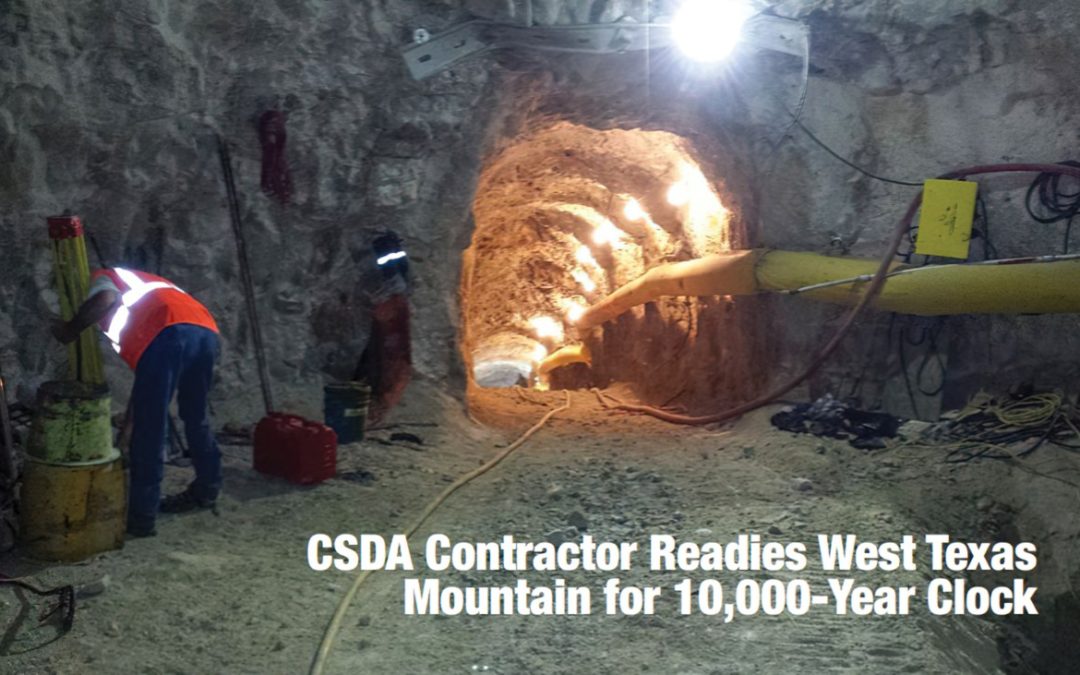
Not only is the concept of a mechanical clock running for 10,000 years a monumental undertaking, but so are the proportions. The Clock in the mountain will be roughly 200-feet tall, located beneath a remote limestone mountain in the Sierra Diablo mountain range in West Texas. Inside the tower, you will enter what the designers refer to as a “crude airlock,” with one stainless steel door followed by another. This chamber is meant to keep as much dust and wildlife out of the actual clock tower as possible. Through here, you walk through a tunnel that is a a few hundred feet long, followed by a 500-foot deep vertical shaft that is about 12-feet in diameter.
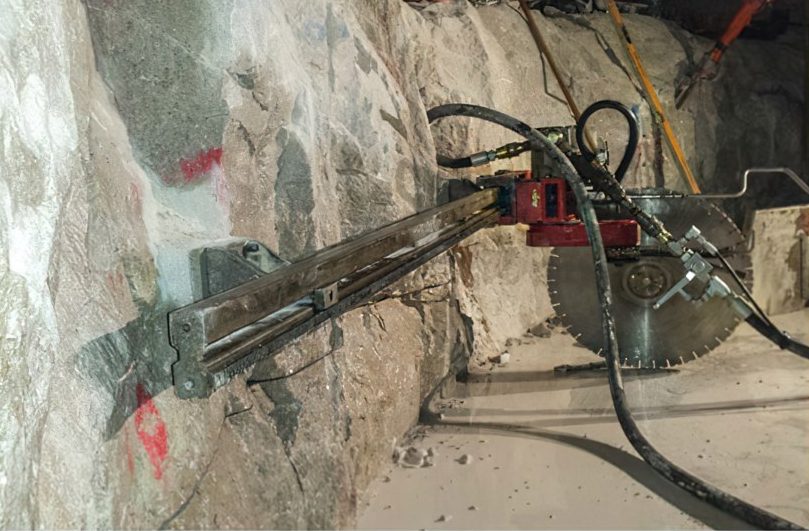
While the machinery of the clock itself is being assembled in California and Seattle, General Contractor Glen Ragsdale Underground Associates from Angwin, California who was in charge of all underground construction, contracted CSDA member Austin Enterprise of Bakersfield, California to assist in readying its future home. The structure for the Clock was carved directly out of the mountain and required a lot of specialty equipment. To prepare the mountain, Austin Enterprise began by flush cutting the concrete chamber floors to an 18-inch depth with a Diamond Products CC8000 curb cut machine in order to achieve the correct chamber size. Next, an Austin operator used a Longyear 360 hydraulic wall saw to create seating and stairs leading out of the chamber walls. Ralph Ortega, the Project Manager for Austin Enterprise describes, “We alternated by cutting individual steps during the day, and then had another contractor, Glen Ragsdale Underground Associates Inc. in to remove the material at night by smooth wall blasting.” By the end of the flush cutting, they had completed 300-linear feet of cutting in the chamber.
Carved into the main chamber are five room-sized anniversary time capsules. The anniversary chambers are designated for the first, tenth, hundredth, thousandth and ten-thousandth year anniversaries. The one-year anniversary chamber contains a special orrery, or planet tracking display, of our solar system that will play annually on a pre-determined date based on solar noon. The other anniversary capsules are yet to be adorned with anything and the designers plan to leave the future designs to future builders.
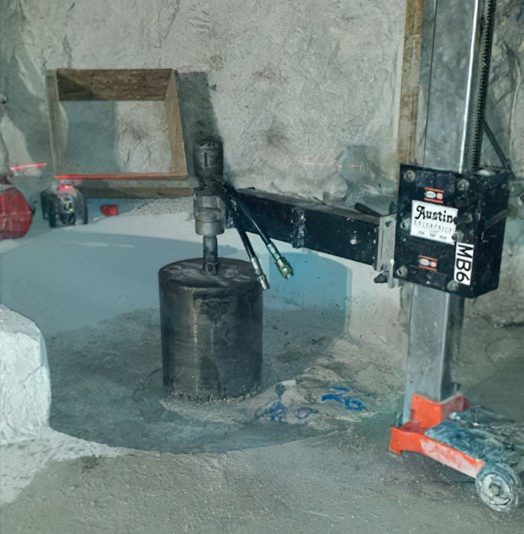
In the anniversary capsules, Austin Enterprise used a Meco 4-speed hydraulic core drill to drill five 72” holes in the chamber, one for each capsule. Five 6” holes for gears to run from the chamber’s center to the time capsules were also drilled. In addition, a Diamond Products CB30EXL Electric Hydraulic Pump Unit wall saw was used to create a 6” trench from the chamber’s center to the time capsules. Lastly, Austin Enterprise used diamond disk grinding to expose the natural limestone in the floors. Diamond blades were the best and obvious choice to provide a smooth, finished surface.
Austin faced several challenges in completing this daunting project. The Clock’s location is a grueling pilgrimage through the west Texas desert to a remote mountain near Van Horn, roughly about 1,500-feet above the scrubby desert. Rough terrain and weather made it difficult for the crew to get their trucks and equipment to the job site, and each trip took anywhere from 45 minutes to an hour to reach the actual site from the jobsite camp. The weather that time of year could be extreme, and the construction started in February, continuing through the punishing summer and concluding in October. However, careful planning from management and the general contractor ensured that trucks and equipment reached the destination successfully each day and that employees remained safe during renovation.
As always, safety was a major concern of everyone onsite. The tedious daily commute through the desert landscape meant everyone involved needed to be sure to protect the natural wildlife, as well as keep themselves safe from any potential dangers. Aside from the desert, the mountain posed its own risks. Once Austin was done sawing and grinding through the chambers, a concern was being able to remove people and equipment through the exits of the extremely confined spaces. Also, because of the confined spaces, water was used to control the dust from the construction. Austin said that they were always acutely aware of their surroundings on this jobsite.
The sawing and drilling of the project was completed on time and regarded as a huge success. Austin Enterprise Project Manager Ralph Ortega stated, “We’re 100% satisfied. We were determined to do this job, overcoming all obstacles throughout the way. Finding solutions to get any job done is what we thrive on and makes us who we are.” Ortega went on to say that he believed Austin Enterprises was chosen for this tough job because of their reputation for being skilled with specialty equipment. CSDA contractors are often selected for difficult and technically challenging jobs such as this one because of their reputation for quality, professionalism and experience.
The Clock will be an incredibly interesting marvel once it is completed, and there is much more to say than has been detailed here. For those interested in keeping up with the progress of the Clock, there is more information at longnow.org, such as the prototypes of the Clock or other Long Now projects, as well as more details and images of the first anniversary orrery. Bezos’s team has created another resource at 10000YearClock.net, with information for the public about the project, a page to send in any suggestions for the tenth anniversary capsule as well as a public sign up page for learning about the eventual visiting opportunities there.
Article reprinted from Concrete Openings | December 2020
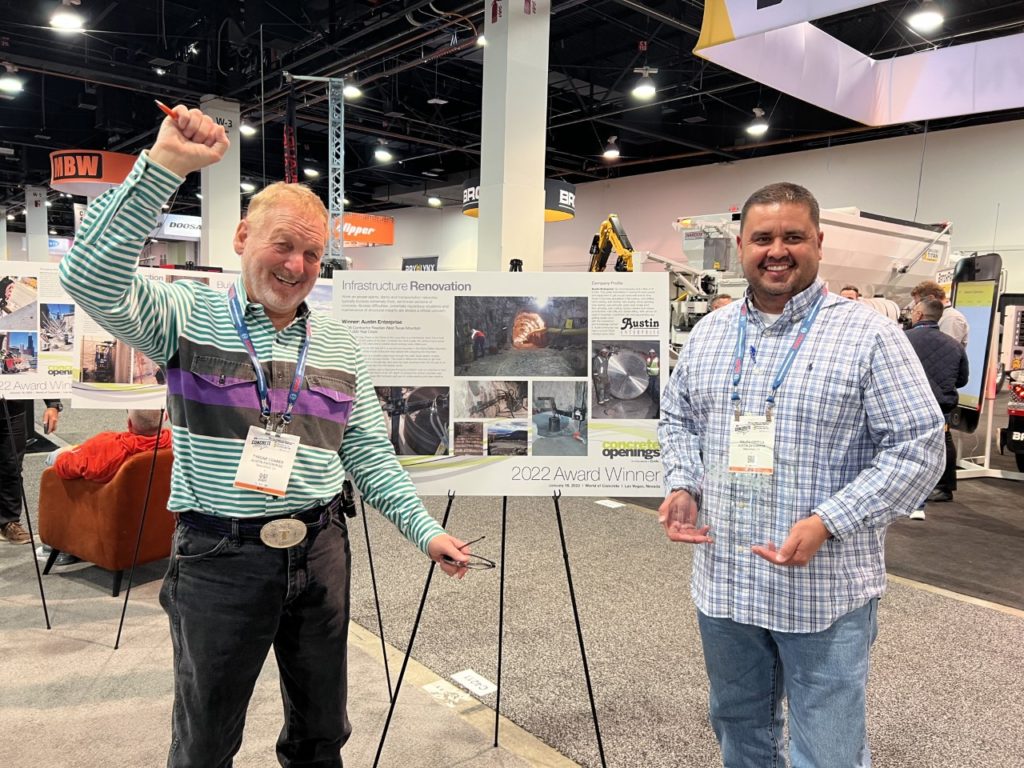
Celebrating the 2022 Infrastructure Renovation award from the CSDA for the 10,000 Year Clock project, featured in the magazine OPENINGS.

by austinenterprises | Jun 1, 2009 | Projects
In Europe, perhaps more so than in the United States, companies who advertise on television have developed extremely clever and memorable advertising. Like many multi-national automobile companies, Honda is known for coming up with highly entertaining ads. From using their individual car parts to create a domino effect, or by using a human choir to recreate the noises of their vehicles (you can find these, and others, on websites like Youtube), this car maker has created ads that get people talking. Their latest idea was no different. The team from Torrance, California-based American Honda wanted to create a musical highway using rumble strips and they wanted their Honda Civic to play a musical score as it traveled over the strips. Rumble strips are the rough patches of road that make a loud noise to wake motorists up if they veer outside a lane. The concept had already been successfully realized in countries like South Korea and Japan; however this would be the first musical highway of its kind in the U.S.
Did you know?
Roadway departments all over the world have spent years experimenting with various devices and measures to guard against accidents while maintaining driver safety. Some are designed to
reduce traffic speeds or ease congestion while others are installed with the intention of keeping correct road position or providing hazard warning notifications.
Audio tactile profiled markings, or rumble strips, are a safety feature that warn drivers of potential dangers or deviations on roadways. They do this by causing vibration and audible rumbling when a car travels over them. These vibrations are transmitted through the wheels into the main chassis of the vehicle, and together with the noise produced, alert off the roadway.
Rumble strips were first implemented on the Garden State Parkway in New Jersey in 1952. Also known as singing shoulders, they provided an alert system to prevent the ever-increasing problem of drivers straying from the roadway. Since this time, research has shown that rumble strips are a highly effective way of reducing many types of accidents and they are cost effective as well. The effectiveness of rumble strips has remained consistent over time, while other road safety measures studied at specific installations have often shown a decline in their effectiveness as drivers become accustomed to them. Cost-benefit analysis have shown that even on relatively low-volume roads, the costs associated with creating rumble strips are quickly exceeded by the economic benefits of improved road safety.
Rumble strips are usually applied in the direction of travel, along an edge or centerline, to alert drivers when they are drifting from their lane, or across the direction of travel to warn drivers of a nearby danger-spot. These strips are created by scalloping or grooving a section from the concrete or asphalt roadway using diamond cutting equipment in a regular pattern. Alternative types of strips can be created by forming raised sections or by adding thermoplastics or cold-applied plastic round or rectangular bumps. Certain types of raised rumble strips also have reflectors built into the edge to increase driver visibility. Round raised rumble devices are sometimes referred to as Bott’s dots. Whether alerting drivers or creating music, rumble strips get the job done.

Building the Musical Highway
RPA of Santa Monica, California, was hired by Honda to create a television commercial featuring the musical highway and the location, a quarter-mile stretch of road in Lancaster, California, was chosen. Pauline East, the Antelope Valley Film Office’s liaison said that the location was picked after Honda said it wanted a sense of community and city lights from one angle and a feeling of openness from the other. RPA heard about CSDA member Austin Enterprise through other road contractors and from employees at the California Department of Transportation (Caltrans). The contractor performs a lot of work for Caltrans on highways and on airport runways creating rumble strips. Many employees of Caltrans knew Ty Conner of Austin Enterprise because of Austin’s largediameter saw blades and grinding heads, and Austin Enterprise was approached to cut the grooves.
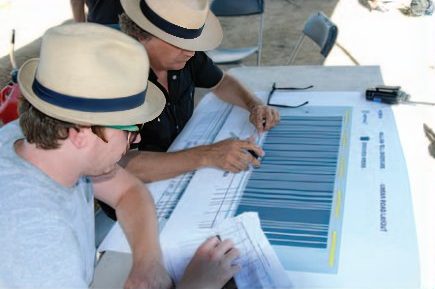
A musical score was translated into a series of strips and the Honda Civic, traveling at a speed of 55 miles per hour, would produce the series of vibrations and “hum” the score. The concept was similar to a record player needle gliding across a vinyl LP. Seven notes were required to create the music for the song that had been selected. Although the notes were repetitious, they were different in that they had varying durations of the note. Varying lengths of blank spaces were also inserted to create the rest of the music. Small blank spaces were used to give definition to each note. Larger spaces were inserted to maintain the beat of the song. Mathematical musicians made the calculations for the notes after three days of test cutting.
It was determined that three factors affected the making of the note: depth of groove, width of groove and spacing between grooves. Just one incorrect calculation and groove would make a big difference in the music that the production company was hoping to create. According to Conner, “Sometimes rumble strips produce too much vibration and noise and I’m called to try and reduce the noise.” He added, “This was one job that was actually fun in that I was called to create noise. Watching Park Pictures produce the commercial was a trip as well.”
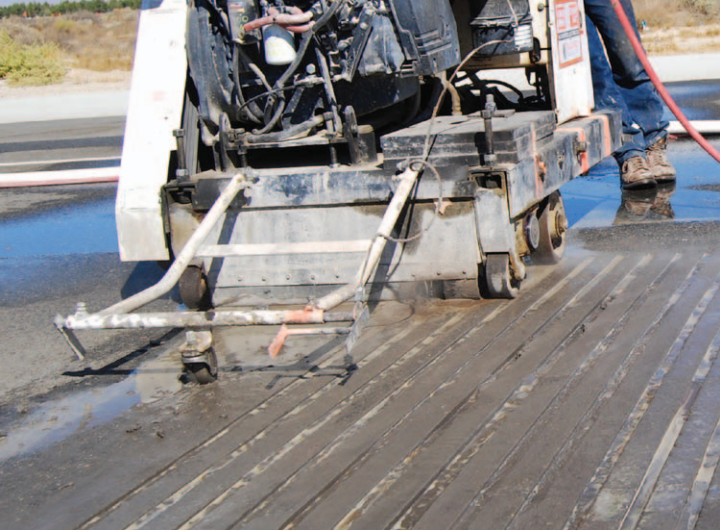
This job had some interesting challenges. The 0.5-inch-deep grooves made transverse to traffic across the 12-foot-wide lane varied from 0.5 to 1 inch in width, with a tight tolerance of 0.05 inches. Great care was also taken to make sure the sections of road in between the cuts were the correct width. “The spacing in between the notes was really important,” said Conner. “The spacing of the strips had to be specific to get the right length of note as well as the right tempo,” added Conner. In addition, the cutters and the production team had to deal with the heat of the California sun which caused the surface of the asphalt pavement to soften. This, in turn, caused some distorting of the grooves so the operators completed a portion of the work at the night.
Austin Enterprise used a Meco 72-horsepower diesel groover with a 24-inch head, together with a 35-horsepower gas groover with a 16-inch head to make the grooves. A full day was taken to configure the grooving heads prior to commencement and 12-inch Diamond Products blades were used with various width spacers. Five operators completed the cuts over three days and eight-hour shifts.
There was a brief moment of panic for Conner and his operators, as they wanted to be the first to try out the musical highway. They proceeded to travel over the series of rumble strips in a 20-foot truck. The size and weight of the truck traveling over the grooves did not exactly produce sweet music, and the cutting team was worried that the project would not be a success. However, once the production crew from Park Pictures traveled over the strips in the test car, the team’s fears were allayed as they heard the excited shouts and screams of the crew, as it was clear that the cuts were correct. The project had been a success.
The stretch of highway in Lancaster soon became an extremely popular section of road, but not for some local residents. Residents complained about the weird noise coming from the road as well as the increased volume of traffic in the area. In addition, some motorists were making illegal U-turns or traveling over the strips in reverse, causing safety concerns. Mark Bozigian, City Manager for Lancaster, made the decision to repave the road to avoid any accidents.
This, too, proved to be an unpopular choice. “I was not a well-liked man,” said Bozigian, who had to deal with approximately 500 complaints about the removal of the strips. He then made the decision to reproduce the strips in a less populated area that would not cause as much disruption. Despite this setback, the city of Lancaster was pleased with the exposure provided by having it’s name and logo included in the commercial, “You can buy that kind of advertising, but not on our budget,” added Bozigian.
Patti Austin of Austin Enterprise, was also pleased to have been involved in such a unique job, “Our operators were overjoyed to hear that it was a success, and we are proud to have been a part of it.”
Watch for the ad that begins with the cutting work taking place, followed by two fellows getting into the car. From there, the ad is shot from the inside the car by a camera mounted in the middle of the back seat, with a microphone that was placed in the trunk that records the sound produced by the tires. The viewer takes the journey from a passenger’s perspective, hearing the tune play out as the car travels along the stretch of road. There are three different versions of the ad with varying lengths, so it will take a sharp eye to spot the shorter versions.
A visit to the westbound stretch of Avenue G between 30th and 40th Streets West in Lancaster, California, might just be worth it for a ride along the Honda Civic musical highway.
Article reprinted from Concrete Openings | June 2009